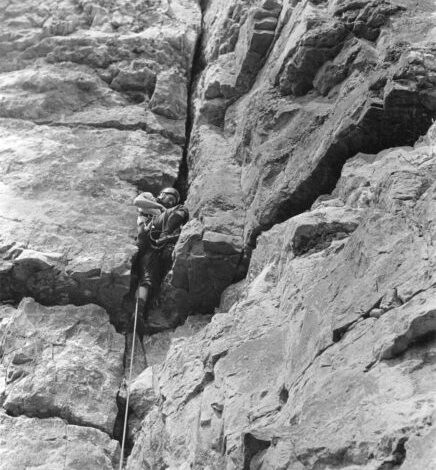
Before Sir Chris Bonington became one of Britain’s greatest mountaineers and led expeditions to Mount Everest, he was among the climbers honing his skills on the towering limestone cliffs of Stoney Middleton.
Ahead of National Mountain Climbing Day on 1st August, visitors are being encouraged to discover the Peak District village. This village helped shape modern British rock climbing during the 1960s and 1970s.
Most people driving through Stoney Middleton have no idea they are passing one of the country’s most significant climbing venues. Yet the limestone cliffs of Middleton Dale attracted many of Britain’s finest climbers, including Bonington. Also, local pioneers Tom Proctor, Geoff Birtles and Jack Street contributed first ascents and challenging new routes. Their achievements helped cement the village’s reputation among the world’s climbing community.





In 1968, Proctor completed Our Father, a route regarded as one of the hardest traditional rock climbs in Britain at the time. As a result, it attracted attention well beyond the Peak District climbing community. Over the following decades, the crags continued to produce routes that challenged the country’s strongest climbers. Moreover, they helped cement the Peak District’s reputation as one of the world’s great climbing destinations.
Today, more than 450 recorded climbing routes thread their way across the limestone cliffs opposite The Cupola Kitchen and Apartments. Climbers continue to travel from across Britain to tackle many of the same routes. These early routes earned the village its reputation more than half a century ago.
For Alison and Colin Hall, owners of The Cupola, it is one of the stories that makes Stoney Middleton unlike anywhere else in the Peak District.
Alison said:
“People often arrive for breakfast, lunch or a weekend away and then notice climbers on the cliffs opposite. They’re fascinated when they discover those cliffs played such an important role in British climbing history.
“For such a small village, Stoney Middleton has an extraordinary number of stories to tell. Within a few minutes’ walk you have internationally important geology, centuries of industrial heritage, caves, walking trails and one of Britain’s most famous limestone climbing crags.
“We’ve always wanted The Cupola to help people discover those stories, not just enjoy great food and somewhere comfortable to stay. Once visitors begin exploring, they often end up staying much longer than they expected.”
Situated on the site of the former Lords Cupola smelting mill, The Cupola has become a gateway to the village’s rich history. Alongside its wood-fired restaurant and luxury Rock Mill Apartments, visitors can explore the Life in a Gorge heritage exhibition. Additionally, they can enjoy walking trails that reveal how this small Derbyshire village has played an unexpectedly significant role in Britain’s industrial, geological and outdoor heritage.
The climbing remains one of Stoney Middleton’s biggest attractions. The limestone walls of Middleton Dale continue to test experienced climbers. Meanwhile, walkers stopping to watch from the roadside can often witness ascents taking place throughout the day.
For Colin, that living connection between past and present is part of what makes the village so special.
“You don’t have to be a climber to appreciate the history here. Seeing people tackle these cliffs while you’re enjoying lunch or setting off for a walk is all part of what makes Stoney Middleton such a memorable place to visit.”
“There’s something wonderful about watching climbers on exactly the same cliffs where so many legends of the sport climbed decades ago,” he added.
For more information, visit thecupola.uk.